The Expression
and a rant about street photography

Yesterday I visited Sydney Modern Project to see Ron Mueck’s Encounter exhibition. I was not in the mood to be part of a crowd, so I skipped the guide and audial aids. I wanted to stroll on my own and go for my own take.
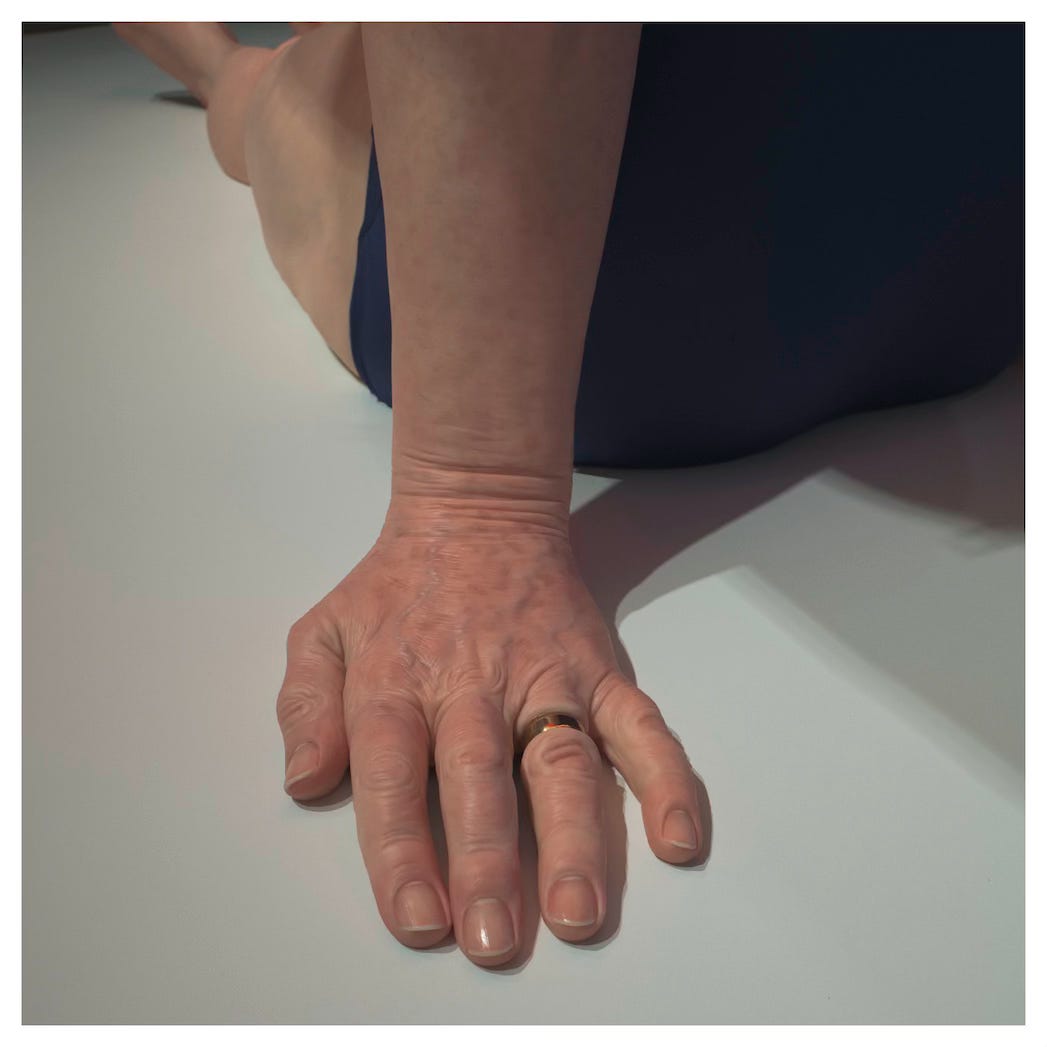
The first thing that struck me was how realistic and detailed the sculptures were; at that stage I could not go any deeper than that. I wondered how on earth they looked so real. For example the foot nails of elderly figures, their typical deformation in colour and shape, brittle and rough texture were truthfully reflected, along with saggy skin, blue veins, sun spots and so on.
The second observation I made was the sculptures were made in different scales, they were either at monumental or smaller scales than the real life human. The reason behind this revealed itself much later, after I finished. I realised Mueck was using available space to zoom in or zoom out, showing us either more or less. I realised he was trying us to see subtle touches of emotion, for example the pressure of fingers on a skin, a wedding ring long embedded in flesh; these minute gestures and traces all express emotions collectively to form a message unique to the sculpture. Perhaps the overall body language wasn’t enough, he wanted us to focus on deeper than the obvious.
Take his sculpture Ghost (1988/2014) for example. The booklet describes it as “a vivid incarnation of adolescent self-consciousness”. At first I almost missed it. From where I approached to it I didn’t see much. But then when I turned around and look at her eyes, I found a young girl in transition from childhood to adulthood, a profound change, confusion, insecurity, and desire to disappear; they were all there; her expression was there.


The exhibition Encounter was a revelation for me at several levels. On the one hand, and once again, I realised art should be savoured slowly. Observation of artwork requires participation and presence, it is not meant to be passive entertainment. Taking time allows us a chance to discover things that we might overlook otherwise. Sometimes we may even discover something about ourselves too.
On the other hand this exhibition reminded me the power of capturing human expressions truthfully in photographs. Then why do I struggle to see those qualities in today’s street photographs?
Today I see less variety in real life expressions and gestures of people. Majority of the time people are passively interacting with their mobile phones; they remain indifferent to life happening around them, even after they put their phones down their frozen face is still there. Everybody too often and too long locks themselves into observing a digital universe.
However before the turn of the millennium we had nobody but each other to observe. We had real life happening around us. Even if we did not participate directly in all social interactions, we had the chance to read expressions of other people and reflect upon them in a variety of ways. Moreover real social life has been happening since the dawn of Humanity. Suddenly we decided to flip the switch and buried ourselves. I observed these things because I am old enough to know both worlds.
Photography as well reflects this change. During 20th century street photography flourished in the West. For me the photographs of that era were more inspiring to look at. Not only photographers cared more about capturing human expressions by getting closer, but people behaved differently too; they reflected their presence in a myriad of different ways, with more gestures and variety in expressions, because they were participating Life, the only one they had, rather than lost in observing an artificial life on their devices. Just open and look at photographs in any photo-book from the era and you will see what I mean.
There are many photographs in Robert Frank’s The Americans, slightly out of focus, or too grainy, or too imperfect by today’s (crooked) standards. But there isn’t a single photograph not inspiring. It is the best photo-book I have ever seen. Genuine human expressions in that book are telling a rich story of America in transition, and telling it candidly; the tenacious grit, sadness and hope once Americans had.
Just look at this photograph. Robert Frank captured a middle aged man sitting on a bench lost in thought, looking at the opposite direction of a student queue just graduating from the college. His look is telling me once he had been just like those youngsters, full of esteem, confidence and hope - but wait till life throws spanners along your way, life is not what you hope for kids. That’s what he is telling me.
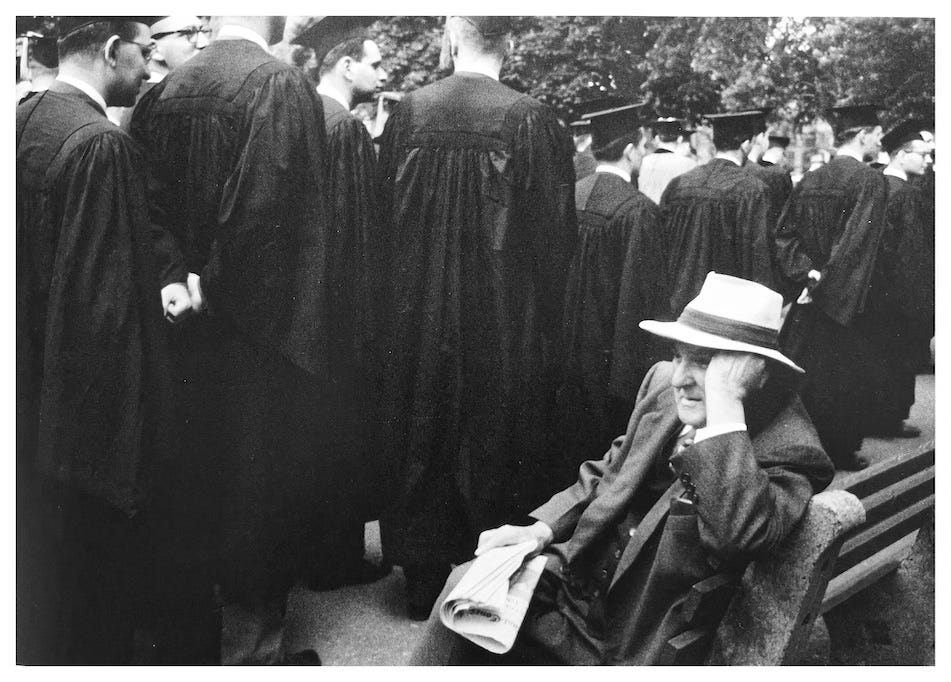
Today the chances of getting a picture like this is zero. There would be a greater chance for the gentleman looking at his iPhone.
I don’t want to sound like a doomsday preacher but perhaps we photographers are unconsciously choosing other ways to combat with lack of inspiration on streets; we just need to accept the new reality. We seem to care less about candid scenes because there aren’t anymore (you are forgiven to think this is a good excuse). Instead we choose motion blur, or we do silhouettes or we shoot demonstrations, events, festivals, low hanging fruit, or worst we foolishly focus on the wrong stuff, “film or digital”, sharpness, megapixels, cameras. In the mean time ordinary everyday life and its scenes became duller and uninspiring before our eyes, because people chose to live in their devices. There is hardly anything is interesting about someone looking at their phone.
The sculptural language of Ron Mueck (born 1958, Melbourne lives England) is built on close observation and emotional force. Mueck’s astonishing creations - psychologically intense and viscerally physical, monumental and minute - tenderly reflect inner worlds of private feeling. - from the booklet Ron Mueck Encounter Exhibition
Times and attitudes are in constant flux. Artists, photographers included, produce what they can from whatever speaks to them. Sometimes it’s literal and visceral. Other times it’s abstract or melancholic. I don’t think we’ve lost anything, it’s just that the world moves on and we move with it.
Wow - I think you have ‘hit the nail on the head’ as they say.
This looks like an inspiring exhibition.